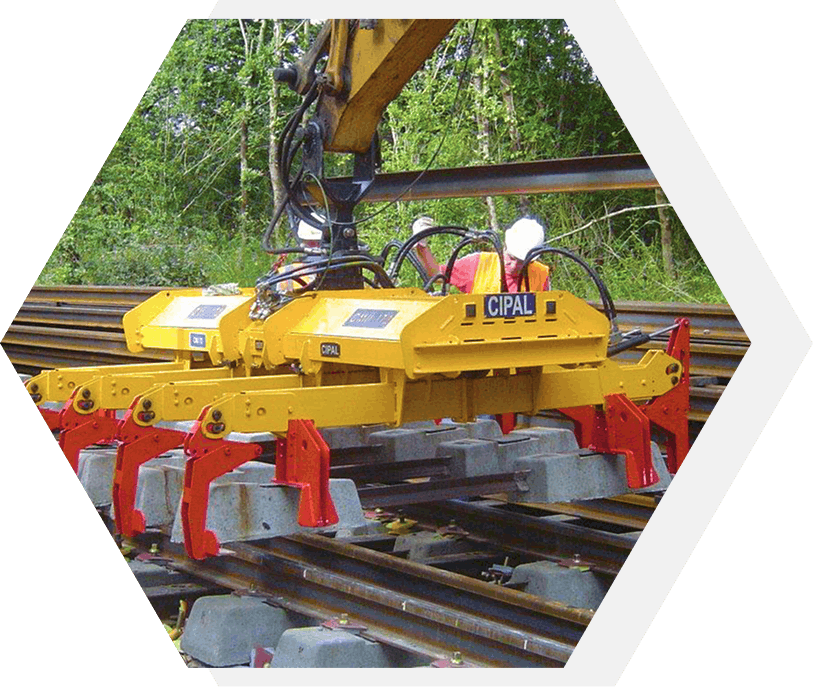



The sequential round bar lifting clamp is a bespoke gripping device. CIPAL designs and manufactures it in compliance with standard NF EN 13155. It thus adapts to a wide range of diameters. Furthermore, it ensures safe and repeatable gripping of bars resting on cradles, without any manual intervention at load level.
Sequential clamp — an operating principle based on component geometry
Its operating principle relies on the geometry of the component. The crane’s lifting motion thus presses both jaws against the bar. The interfaces furthermore provide obstacle gripping on the lower section. The sequential system consequently enables automatic pick-up and release in complete safety. The safe working load (SWL) is moreover marked directly on the tool for rapid identification in the field.
A solution adapted to each steelwork workshop
CIPAL adapts each clamp to the specific constraints of the application: bar diameter, cradle configuration and type of overhead crane. Built without load-bearing welds, it thus follows a durability logic that reduces maintenance costs. Its high wear-resistance materials furthermore guarantee reliable performance. Each configuration therefore meets a precise productivity and safety requirement in steelwork workshops.
Applications across steelwork and metal processing industries
This clamp finds applications across a wide range of industrial sectors. It is thus particularly suited to the handling of round bars and billets under overhead travelling crane. Foundries and forging workshops furthermore benefit from its automatic sequential pick-up and placement on cradles. Moreover, it reduces manual intervention and improves safety at every stage. It is consequently a reference tool for companies working at intensive output in steelwork environments.
The engineering department sizes each clamp according to the specific constraints of the application. It takes into account the type of lifting equipment, frequency of use and the operating environment. Every unit is moreover delivered with a complete technical file: operating instructions, structural calculations and CE marking.